The Art of Spending Money, How to Enjoy What You Earn Without Guilt
 Garv
GarvAug 16, 2026 7 min read

You earn more than you used to. The balance is healthier than it has ever been. And you still pause over the bill at dinner, still feel a small flinch upgrading the seat, still have not bought the thing you have been quietly wanting for three years.
Nothing has gone wrong. You simply learned one half of the skill and never learned the other. You got very good at earning it and keeping it, and nobody ever taught you how to convert it into an actual life.
Because that is the part people miss. Money you never turn into anything is not wealth. It is a number.
The habits that got you here are the ones stopping you now
The carefulness was not a mistake. If you came from a house where money was tight, or you built something from nothing, then the vigilance was correct. It kept you safe. It probably worked.
The trouble is that it does not switch itself off when the circumstances change. The mind keeps running the software that was written for the old situation, and it keeps running it long after the emergency has passed. So the flinch you feel at a restaurant is not really about this bill. It is much older than your bank balance, and it is answering a question nobody is asking any more.
Which produces a strange outcome. People spend twenty years trying to reach a point of comfort, arrive, and then cannot feel it. The safety is real and the sense of safety never turns up.
The miser and the spendthrift have the same disease
Here is the thing that reframes it.
We think of these as opposites. One person cannot stop buying, the other cannot bear to spend. But look at what they have in common: in both lives, money is the main character. Every decision routes through it. Both people are being run by the same thing, just in different directions.
Real freedom around money is not having a lot of it, and it is not spending a lot of it. It is money no longer being the thing your attention keeps orbiting. Someone who agonises for a week over a reasonable purchase they can easily afford is not being disciplined. They are as occupied by money as the person who cannot walk past a shop.
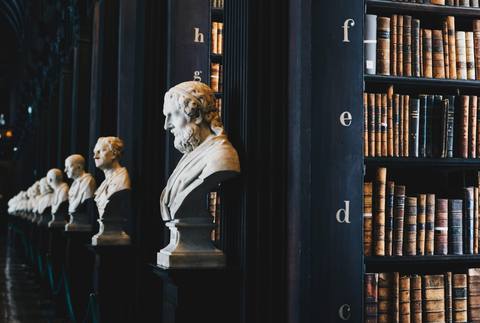
Seneca was extremely rich, and had to defend it
This is where people get Stoicism wrong. They assume it means austerity, sleeping on the floor, refusing pleasure.
Seneca was one of the wealthiest men in Rome. Enormous fortune, property, the lot. He was attacked for it in his own lifetime, and the charge was the obvious one: how does a philosopher who writes about the dangers of luxury end up this rich?
His answer, in his essay on the happy life, is the useful part. He argued that the wise person does not love wealth but does prefer it, does not refuse what fortune offers but holds it in a way that it could be taken away without taking him with it. Wealth in the hands of a wise person is a servant, he said, and in the hands of a fool it is a master.
Note what that makes the test. It is not how much you spend, and it is not how little. It is whether losing it would unmake you. You can fail that test while spending nothing, which is precisely the situation this article is about.
And it is worth saying plainly that Seneca is open to the hypocrisy charge here, and knew it. He does not fully escape it. But the argument stands on its own regardless of how well he lived up to it: money is worth having and not worth being, and wanting less is a discipline that can curdle into its own kind of fixation.
Not all spending returns the same thing
There is a craft here, which is why this is not simply permission to be careless.
Some money converts into life at a very good rate. Experiences you will still be describing in ten years. Buying back your own time, whether that is a flight instead of a drive or paying someone to do the thing you dread. Removing a small recurring friction you have tolerated for years. And spending on other people, which is reliably among the least regretted money anyone spends.
Other money converts badly. Anything bought mainly to be seen. Anything you will fully adapt to within a month, where the pleasure evaporates and only the payment remains, which is the mechanism behind never feeling like you have enough.
So the question is not should I spend this. It is: am I buying life, or am I buying an image? The first is what money is for. The second costs far more than the price on the tag, and no amount of it ever quite lands.
The line this advice sits above
Now the caveat, and it is not decorative.
Everything above applies only if the money is genuinely surplus. If you are carrying expensive debt, or you have no cushion, or the spending would be funded by a card you cannot clear, then “let go and enjoy it” is not wisdom. It is a pleasant sentence that makes a bad situation worse, and there is a whole industry built on selling exactly that feeling to people who cannot afford it.
The permission described here is for a specific person: the one who has already done the difficult part, who has the margin, and who cannot make themselves use it. If that is not you yet, the earlier discipline is still the right discipline, and there is no shame in that being the current chapter.
Be honest about which one you are. The answer is usually obvious once you actually look at the numbers rather than the feeling.
How to practise it
Start with one thing and treat it as data. Buy something you would normally talk yourself out of, well within your means, and then pay attention. Did it return anything? Some things will and some will not, and you cannot learn the difference by theorising about it.
Decide the amount while you are calm. Set aside a figure that is explicitly for enjoyment. A budget for pleasure is still a budget, and the point is that the decision gets made in advance, so the moment of spending does not have to carry any guilt. You already approved it.
Spend some of it on other people. It is the version that almost nobody regrets, and it quietly loosens the grip better than anything aimed at yourself.
Notice the flinch without obeying it. You do not need to argue with it or make it disappear. Just recognise it as an old reflex reporting for duty, thank it for its service, and proceed anyway.
The aim was never to stop caring about money. It is to stop money being the thing that decides how you feel, in either direction. Guarding every pound is not the opposite of greed. It is the same preoccupation wearing more respectable clothes.
You earned it. At some point it has to become something other than a high score.
Frequently asked questions
Why do I feel guilty spending money I have earned?
Usually because the carefulness was learned in a period when it was genuinely necessary, and habits formed under scarcity do not switch off automatically when the scarcity ends. The flinch is answering an old question rather than the current one. It helps to check the actual numbers rather than the feeling, and to decide in advance what portion of your money is for enjoyment, so the decision is already made before the moment arrives.
Does Stoicism say money is bad?
No. The Stoics treated wealth as a preferred indifferent, meaning it is worth having but not what makes a life good. Seneca, who was extremely rich, argued that the wise person does not love wealth but does prefer it, and holds it so that losing it would not destroy them. The test is not how much you spend or save, but whether money is running your attention. By that standard, anxious hoarding fails the test just as surely as compulsive buying does.
Get one like it every morning.
Free daily Stoic wisdom — one minute, real practice.