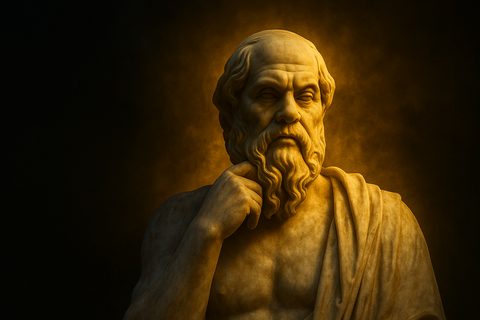
Who Was Epictetus? The Slave Who Became the Teacher
 Garv
GarvJun 3, 2026 5 min read

Epictetus was a Greek Stoic philosopher who lived from around 50 to 135 AD. Born into slavery, he was freed as a young man and went on to found his own school. He wrote nothing himself, but his teachings on freedom and self control were recorded by a student and shaped every Stoic after him.
Of the three great Stoics, two held power. Marcus ran an empire. Seneca advised one. And then there is Epictetus, who started life as someone else’s property.
The man who owned nothing, who could be bought and sold, became the one who taught the world what freedom actually means. If that does not get your attention, nothing will.
How does a slave become a philosopher?
Slowly, and against every odd.
Epictetus was born into slavery in what is now Turkey and spent his early life as the property of a wealthy freedman in Rome. Somewhere in there he was allowed to study Stoic philosophy, and he took to it like air. He also lived with a disability, a leg that left him lame, which one ancient story blames on a master’s cruelty.
When he was freed, he began to teach. Eventually he was pushed out of Rome along with other philosophers and set up a school in Greece, where students traveled from across the empire to hear him. The slave had become the master, in the only sense that mattered to him.
Why did Epictetus never write a book?
Because he thought living it mattered more than recording it.
Everything we have from Epictetus comes secondhand. A devoted student named Arrian took notes on his lectures and published them as the Discourses, then boiled the core down into a short handbook called the Enchiridion, which simply means “ready at hand.” It was meant to be small enough to carry and live by.
So the most quotable Stoic of all never wrote a word for us on purpose. We only have him because someone in the room understood that this needed to be saved.
What is the one idea Epictetus is famous for?
That some things are up to you, and some are not, and almost all of your peace depends on telling the two apart.
This is the dichotomy of control, and while every Stoic taught it, Epictetus is the one who hammered it into its sharpest form. Your judgments, your choices, your effort, those are yours. Your body, your reputation, your possessions, what other people think, those are not. Suffering, he taught, comes from demanding control over the second list.
“Make the best use of what is in your power, and take the rest as it happens.”
Epictetus, Enchiridion
Read that line slowly. It is the entire philosophy folded into a single sentence.
What did Epictetus mean by freedom?
Not the kind you are thinking of. This is the part that hits hardest given where he came from.
A man who had been literally enslaved was not interested in freedom as a legal status. He had won that and found it was not the point. The freedom he cared about was inner. The ability to keep your will, your character, and your peace no matter what is done to your body or your circumstances. A free man, to Epictetus, is one nobody can disturb, because he has stopped needing anything outside his own control.
“First say to yourself what you would be; and then do what you have to do.”
Epictetus, Discourses
Coming from anyone else that might sound like a slogan. Coming from a former slave, it sounds like hard won truth.
Who did Epictetus influence?
The most powerful man in the world, for one.
Marcus Aurelius, the emperor, studied Epictetus closely and quotes him with deep respect in his own Meditations. Sit with that picture for a second. An emperor taking moral instruction from the recorded words of a man who had been a slave. To both of them that was not strange at all. Status was external. Character was the only thing that ranked a person, and on that scale Epictetus stood as tall as anyone.
His reach runs right up to today. Cognitive behavioral therapy, one of the most effective modern treatments for anxiety and depression, traces part of its core idea, that our thoughts shape our suffering, straight back to Epictetus.
Where should you start with Epictetus?
The Enchiridion, without question.
It is short, you can read it in a sitting, and it is built to be returned to. Do not expect warmth. Epictetus is blunt, almost drill instructor blunt, and that is the point. He is not trying to comfort you. He is trying to free you, and he assumes you are tough enough to hear it straight.
Frequently asked questions
Who was Epictetus?
Epictetus was a Greek Stoic philosopher who lived from roughly 50 to 135 AD. He was born a slave, later freed, and founded a school of philosophy. He left no writings himself, but his lectures were recorded by his student Arrian as the Discourses and the Enchiridion.
Was Epictetus really a slave?
Yes. He spent his early life enslaved in Rome before being freed. His origin is a large part of why his teaching on inner freedom carries so much weight. He spoke about freedom as someone who had truly known the absence of it.
What did Epictetus write?
Nothing, directly. Everything attributed to him was recorded by his student Arrian. The two surviving works are the Discourses, a record of his lectures, and the Enchiridion, a short handbook of his core teachings.
What is the Enchiridion?
The Enchiridion is a brief handbook of Epictetus’s main ideas, compiled by Arrian. The name means “ready at hand,” because it was meant to be carried and used daily. It is one of the shortest and most practical works in all of Stoicism.
Get one like it every morning.
Free daily Stoic wisdom — one minute, real practice.